

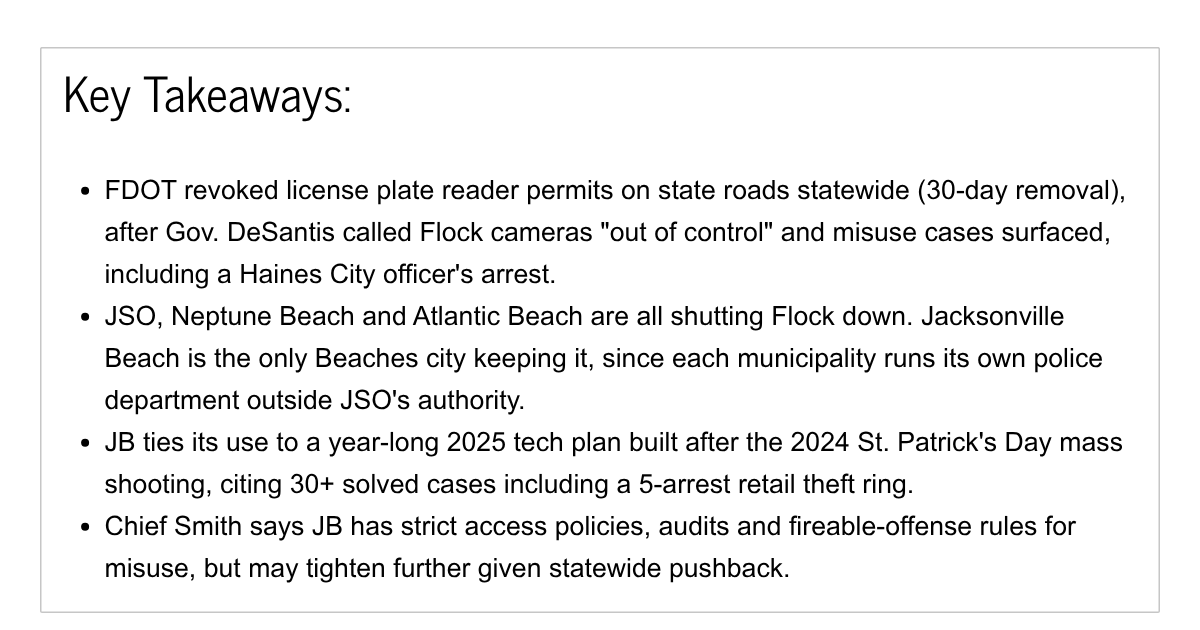
State and local law enforcement agencies across Northeast Florida moved this week to shut down automated license plate reader programs, days after Gov. Ron DeSantis called the technology "out of control" and the Florida Department of Transportation revoked permits allowing the pole-mounted cameras on state road right of way.
The Florida Department of Transportation notified law enforcement agencies Monday that all license plate reader permits on state roads were revoked, giving agencies 30 days to remove the devices. Most of the cameras are manufactured and operated by the Atlanta-based company Flock Safety, which photographs the rear of passing vehicles on public roads and lets participating police agencies search the images against a shared, cross-jurisdictional database.
The order came after weeks of mounting scrutiny over how officers have used access to the systems. In Haines City in Polk County, FL, Officer Christopher Goodson was arrested after investigators alleged he searched Flock data for his estranged wife's vehicle more than 700 times between September 2024 and June 2026, allegedly logging false justifications for the searches. Similar misuse cases have surfaced elsewhere in Florida and nationally, and Flock Safety has since announced it will shorten its default data retention window and require searches to be tied to case codes by the end of the year.
Duval County shuts it down
Jacksonville Sheriff T.K. Waters announced Monday that the Jacksonville Sheriff’s Office would comply with the state's directive and stop using license plate readers "effective immediately," ending the agency's arrangement with Flock. Waters, along with the sheriffs of Clay, Nassau and Putnam counties, cited both the state action and local privacy concerns in halting the programs. Waters called the technology "an enormously valuable investigative tool" in solving crimes and locating missing people even as he ordered its discontinuation.
Neptune Beach followed suit. Chief Michael J. Key Jr. said in a statement that, effective immediately, the Neptune Beach Police Department would discontinue use of license plate reader technology on roadways within the city, citing both the FDOT revocation and ongoing community discussions. Key said the systems had aided investigations, helped locate missing people, aided in the recovery of stolen property and helped solve numerous crimes, but said the state's decision and community concerns made discontinuing the technology "the appropriate action." He said the department remains committed to protecting residents "through every other available means."
Atlantic Beach is also stepping back from the technology. City Manager Kevin Hogencamp notified city commissioners this week that Atlantic Beach is suspending its use of Flock Safety technology and will no longer use automated license plate readers across municipal operations. Hogencamp invited commissioners to raise questions or feedback on the decision.
That leaves Jacksonville Beach as the lone Beaches municipality continuing to operate the system.
The Beaches: independent departments, independent decisions
Jacksonville Beach, Neptune Beach and Atlantic Beach are not covered by JSO's decision. Each city operates its own independent police department outside Jacksonville's consolidated city-county government, meaning Sheriff Waters' order affects only the consolidated city of Jacksonville, not the three Beaches municipalities. Any decision on whether to continue or discontinue Flock camera use in Jacksonville Beach, Neptune Beach or Atlantic Beach rests with each city's own police department and elected officials.
Jacksonville Beach is taking a different path, one rooted in a technology plan the department and the City Council spent more than a year developing. Unlike the policy reversals playing out elsewhere in Northeast Florida this week, Jacksonville Beach's continued use of license plate reader technology links back to the Public Safety Technology Enhancement Plan the department finalized in August 2025, following a City Council strategic planning session.
The technology plan places license plate readers, along with the department's other priorities, against a broader public safety buildup that followed a mass shooting in the city's downtown entertainment district on St. Patrick's Day 2024, an incident the plan describes as galvanizing city leadership, police union leaders and the community behind new investment in officer staffing, compensation and equipment.
Jacksonville Police Chief Gene Paul Smith has repeatedly noted the department's technology and staffing needs due to the scale of visitors passing through a small city. The use of technology can be a force multiplier, which is critical for a municipality that experiences swarms of visitors during peak months.
In an after-action report following the 2024 St. Patrick's Day shootings, Smith described Jacksonville Beach as roughly nine square miles with a population of about 24,000 that has been called a "playground for" a surrounding county of one million residents, citing miles of public beach, about 80 alcohol-serving bars and restaurants and near-weekly special events that draw an estimated 5.1 million to 8 million visitors a year.
Department officials point to specific cases as evidence of the technology's value. Flock cameras have assisted Jacksonville Beach police in solving more than 30 cases, department officials said, including a retail theft ring investigation that led to the arrests of five people this spring.
The Jacksonville Beach Police Department received reports on April 9 linking 24 retail thefts between Jan. 2 and April 9 at the Jacksonville Beach Home Depot, amounting to more than $22,000 in stolen merchandise. Detective Filbert of the General Investigations Unit partnered with Home Depot loss prevention personnel to identify those responsible. On April 13, detectives learned the suspects had just committed another theft at a Home Depot in Jacksonville and were believed to be headed to the Jacksonville Beach store. With assistance from GIU detectives, Downtown CAPE officers and patrol officers, police located the suspects' vehicle and took four people into custody, recovering nearly $2,500 in stolen merchandise. Detectives later identified two additional suspects connected to the ring; one has since been arrested, and the other has an outstanding warrant. Collectively, the five defendants face 97 criminal charges.
Chief Smith said Jacksonville Beach follows strict policies and procedures governing the use of any law enforcement database, including the Flock system. Officers receive regular training and may access the system only for case-specific purposes, he said. Personal use of a law enforcement database is a firable offense, Smith said, and the department conducts regular random audits of system use.
Smith noted that given the public pushback the technology has drawn statewide, the city may decide to adopt stricter policies and procedures governing its use, but he described license plate readers as an important tool in law enforcement's technology tool-belt.
Surveillance Technologies
Surveillance technology similar to Flock's cameras, including doorbell cameras, retail facial recognition, license plate tracking by private repossession and parking companies, and data brokers that buy and sell location information, is largely ubiquitous in the private sector and often operates with few legal restrictions on collection, retention or resale.
Government use of the same categories of technology, by contrast, is subject to public records law, use-of-force and search policies, audit requirements and, increasingly, direct legislative and executive oversight, as this week's actions by the governor and the Florida Department of Transportation illustrate.
City officials continue discussing how to balance the city's use of license plate readers and other public-safety technology with residents' privacy concerns.
Read the public statement issued by JBPD on 9/3/26.


