

Jacksonville Beach's city manager opened a special briefing on July 6 with a line he attributed to a former colleague: hope is not a strategy.
Over the next 90 minutes, City Manager Mike Staffopoulos and Chief Financial Officer Ashley Gossett walked the City Council through a 40-slide presentation explaining what would happen to the city's finances if Florida voters approve a constitutional amendment in November that would raise the homestead exemption to $150,000 in 2027 and $250,000 in 2028.
The constitutional amendment, titled "Save Our Homes from Excessive Property Taxes," was passed on June 2 during a special legislative session. The goal is to provide tax relief for Florida's property owners who reside in their home and claim the homestead exemption.
In Jacksonville Beach homesteaded properties account for 41.4 percent of the city's property tax revenue and 23 percent of the General Fund. The General Fund pays for police, parks, streets, planning, the city attorney and the clerk.
Staff provided the City Council with six options to address potential revenue losses. Council asked staff to put dollar figures on the menu of options that include a citywide fire fee, neighborhood streetlight assessments, expanded paid parking, closing the city's South End Community Redevelopment Area, and, as a last resort, raising the millage rate.
"This is not a recession," the city manager told the council, referencing how recessions have a temporary impact on city finances. "This is permanent and it needs to be treated as such. If this goes through, this revenue is gone; it's not coming back."
Where the money actually comes from
Much of the first half-hour was basic public finance 101, and deliberately so. Council members and staff repeatedly returned to the same point: most residents do not know how little of their property tax bill stays in Jacksonville Beach.
The city's millage rate is 3.9947 mills, where it has sat for at least eight years. The state average for municipalities is 4.8 mills, and Florida law caps cities at 10 mills. A homesteaded property at the city's median assessed value of $322,820 pays a total tax bill of $5,191, according to the city's presentation.
Of that $5,191, exactly $1,090 goes to Jacksonville Beach, about 21 percent. The City of Jacksonville takes $2,156 at 7.9012 mills. The Duval County School Board takes $1,889 at 6.3430 mills. The St. Johns River Water Management District and the Florida Inland Navigation District split the remaining $56.
"A lot of people don't realize where their tax dollars are going, and that only twenty-one percent are going to Jacksonville Beach," said Council member Sandy Golding. "I don't know how many people I've talked to."
The second piece of public finance 101 concerned the city's own budget. Jacksonville Beach adopted a $248 million budget for fiscal year 2026. But most of that is in enterprise funds that are collected from ratepayers and reinvested in their own systems, such as Beaches Energy Services, water, sewer, and sanitation. There are also restricted funds, like the building division and gas tax revenue, that can only be spent on specified purposes.
The general fund, where property taxes are deposited, is $33,033,348. That is 13.3 percent of the total budget. Roughly 57 percent of general fund revenue comes from ad valorem taxes, combined from homesteaded and non-homesteaded properties. Fifty-two percent of general fund spending goes to public safety.
What the amendment does
The ballot measure would raise the homestead exemption to $150,000 effective January 1, 2027, and to $250,000 on January 1, 2028, with the exemption indexed to the Consumer Price Index beginning in 2029. Residents with fewer than five years of residency would qualify only for the current $50,000 exemption until the residency requirement is waived on January 1, 2030.
The measure would also cut the maximum annual assessment increase on non-homesteaded property from 10 percent to 5 percent, beginning in 2027. Jacksonville Beach has 12,700 non-homesteaded parcels, or 46% of its taxable parcels. These include commercial properties, rentals, and second homes.
The measure also requires a schedule for the full elimination of homestead property taxes, but does not specify when that elimination must occur. Staffopoulos told the council the bill's sponsor deflected that question during floor debate, saying the timing was for a future Legislature to determine.
Should the measure pass, Jacksonville Beach's share would fall from $1,090 to $690 to $291. The City of Jacksonville's falls from $2,156 to $575. In practical terms, the city's slice of a resident's tax bill drops from just over 21 percent to a little more than 10 percent.
Half the city stops paying
The parcel data drew the sharpest reaction. Jacksonville Beach has 12,700 parcels. Homesteaded properties account for 6,800 of them, or 54 percent, a figure Council member Dan Janson said was lower than he expected.
Staff ran the proposed exemption tiers against the city's rolls. Under the current $50,000 exemption, 159 homesteaded parcels pay nothing in city property tax. At $150,000, that number rises to 984. At $250,000, it reaches 2,322 — roughly 18 percent of all parcels in the city. Under full elimination, all 6,800 homesteaded parcels are removed from the rolls.
Homesteaded properties currently generate $7,447,000 of the general fund's $17,994,000 in ad valorem revenue. Non-homesteaded properties generate $10,547,000. Those figures come from the Duval County Property Appraiser as of May 28 and are prospective — closer to what the city expects for fiscal year 2027 than to the budget the council has already adopted, Gossett cautioned.
Restricted, but not really
The measure would also restrict how ad valorem revenue can be spent. The presentation listed seven permitted categories: public safety; education and public schools; financing or refinancing infrastructure; financing or refinancing natural resource projects; issuing local bonds and servicing debt; meeting retirement obligations for local employees; and funding operations and administration for cities and the expenditures of governing bodies.
That last category, added by a late amendment, effectively swallows the other six. Staffopoulos noted that the amendment basically says if it is legal and the council approves it, you can spend it on it.
"So with that, we view that there's probably very little things that would impact on what we do," Council member John Wagner said.
The menu
Staff organized the options into five categories: service reductions, eliminations, or shifts; new or enhanced transfers into the general fund; new or increased fees; special assessments; and a millage increase.
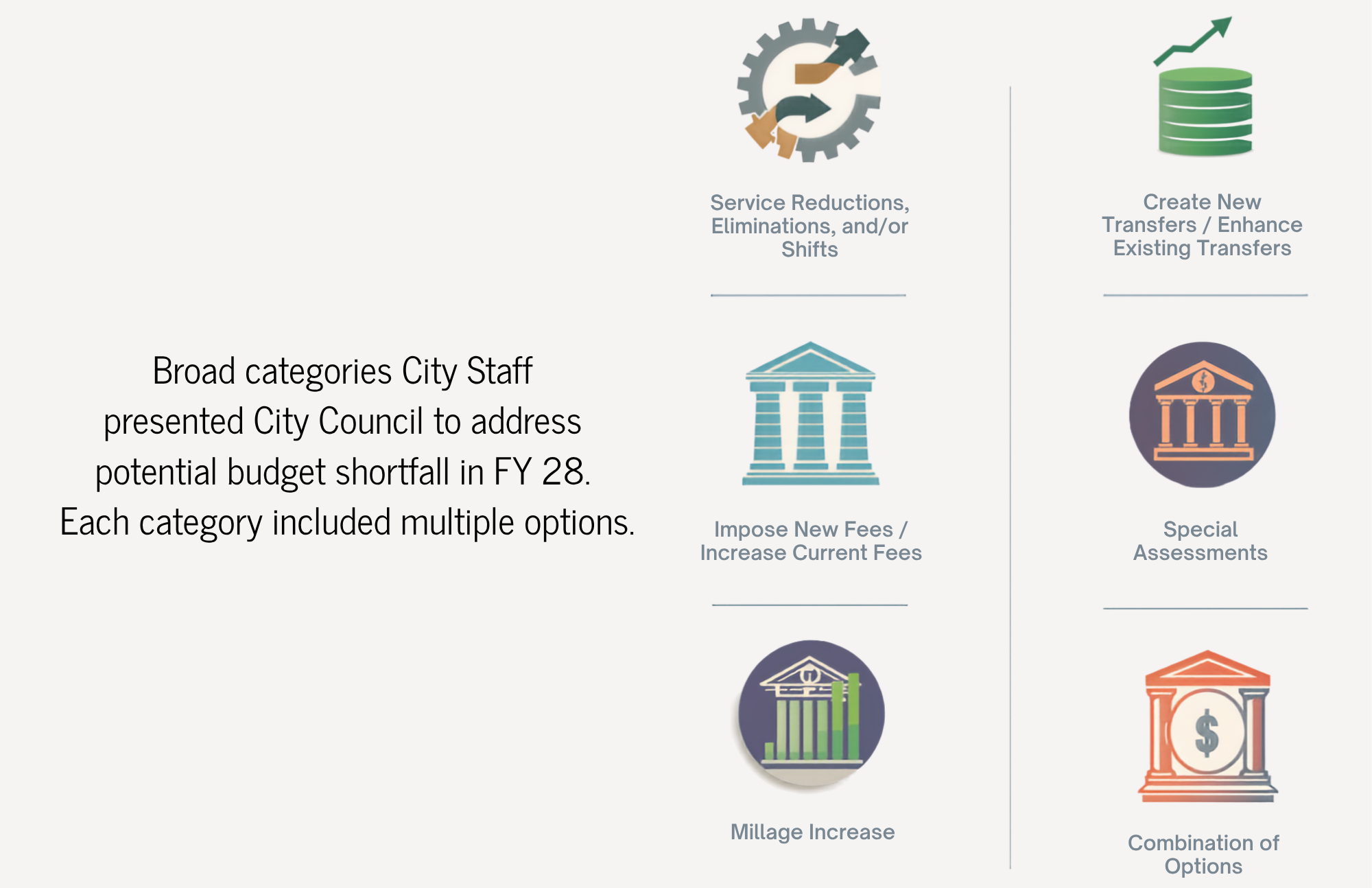
The presentation flagged large expenditures and revenues, anything with a six-figure impact or greater, because, as Staffopoulos put it, $4 million is not a nickels-and-dimes number.
The largest single lever is a citywide fire fee. Jacksonville Beach contracts with Jacksonville Fire and Rescue (JFRD) for the operation of two stations at current staffing levels, at a cost of roughly $3.2 to $3.3 million per year under a thirty-year agreement now in year seven. Florida law permits cities to assess a fee on every parcel for fire and EMS services. Staff estimated a fee could generate up to $3.5 million, covering the JFRD contract and the fire marshal's office.
The fee would apply to all 12,700 parcels, not only the 6,800 homesteaded ones. Council member Bill Horn asked how the fee would be assessed. The city manager explained that the methodology typically assigns a flat fee to residential properties, while commercial and industrial parcels pay a base fee plus a per-square-foot charge. Establishing one takes six to twelve months and requires public hearings. It is the option with the longest runway, which is why staff asked whether the council wanted preliminary work to start before November.
Closing the South End Community Redevelopment Area (CRA) would return money to the general fund, but less than it appears. Jacksonville Beach has two CRA districts: the South End District and the Downtown District, each with a fund restricted to projects within the district. These funds are financed through a portion of the ad valorem taxes paid by property owners within each district. When closed, those revenues will be split between the city and the county.
Gossett told the council that the city currently receives about $1 million a year in reimbursement from the district. Closing the district outright today would yield $2.2 million; closing it after full homestead exemption would yield $960,000, which is less than the city receives under the existing arrangement.
Seventy percent of the South End district's parcels are homesteaded. Downtown, only 28 percent of the district's assessed value is.
Mayor Chris Hoffman said, “It’s interesting that the south end has so many homesteaded properties because that's going to plummet for Jacksonville and for us. Even if we end it, it's not going to be really worth it.” She asked for the full breakdown before making any decision.
Streetlight districts would generate roughly $250,000. The city currently pays for streetlights in residential neighborhoods out of the general fund; the option would divide the city into neighborhoods, count the lights, and assess residents for their share.
Another option is to expand and extend paid parking. It currently generates just under $1 million gross today, of which the city keeps about $750,000. The program runs Friday evening through Sunday during the beach season, in city lots and on-street between roughly Third Avenue South and Sixth Street North. Staff said the council could expand the geography, days, season, and rate.
Another option is to transfer $100,000 annually from the golf course, which now contributes nothing to the general fund and holds $5.5 million in reserve. Hoffman noted the desire to keep the level of service at what residents and visitors expect, but that “we also put a lot of general fund money into the golf course over the years. So that sounds like a really healthy reserve, so I think that's something we should definitely at least do.”
Staff flagged roadway resurfacing assessments of about $300,000 per year as potentially politically infeasible. They also proposed asking the Beaches legislative delegation to expand the permitted uses of convention and development tax funds, which can be used to construct park facilities but not to maintain them.
If the council chose to close the gap through millage alone, the $250,000 exemption would require an increase of 0.9317 mills on top of the current 3.9947 — a burden falling entirely on non-homesteaded property. Full elimination would require 2.7262 mills.
Where the council pushed back
The mood turned when the fee options came up.
"This reminds me of when you check in for your flight, and they charge you for your suitcase, or you go to a hotel, and they charge you for parking," Hoffman said. "If I live on a street with a streetlight, that should be paid for out of my property taxes. This is giving me, and should be giving us all, a lot of anxiety and pause on what this is going to look like if this amendment passes."
Wagner pushed back, arguing that some small-dollar items may be worth doing for optics even where the revenue is marginal, and that the council should look at everything. Hoffman did not concede the point. "I just know the feeling I get when I have to pay to bring a bag on a plane."
Janson drew a line at public safety. “Given my background, of course, everybody knows what I'm going to say: I wouldn't touch public safety, and that's our primary responsibility.”
Horn objected to any change to free parking for residents while pressing staff to study year-round paid parking at Sunshine Park, where he said non-resident visitors are damaging city facilities. “If we're going to have people come in there that are going to damage it, at least let's charge them to park there.”
Council Member Wouters noted the increase of $25 million in the City's budget between 2020 and 2026 and that spending has increased at the same rate. "I think we can solve this without taxing our citizens any more."
Council directed staff to price everything on the list, including the streetlight districts that at least two members said they opposed. "I don't think it hurts to put a number or even just the information," Hoffman said.
The Jacksonville problem
The larger unknown is not what Jacksonville Beach does. It is what Jacksonville does.
Under the interlocal agreement between the two cities, the level of service provided throughout Jacksonville must be provided in the beach communities. The city manager sketched the risk plainly. If Jacksonville reduces fire and rescue service to absorb its own losses, a figure the consolidated government has put in excess of $300 million, Jacksonville Beach could see its contract cost fall and a station close.
A 2024 statute, Section 166.241, Florida Statutes, prevents a local government from cutting its public safety budget by more than 5 percent without triggering a state audit. But it does not require growth of the public safety budget as the population grows. Jacksonville could hold its fire spending flat indefinitely.
"So at some point in time, we're going to need a point of view," Wagner said, asking staff to assess whether the interlocal agreement still delivers a net benefit given how much Beaches money flows to Jacksonville.
Janson cautioned against opening the interlocal agreements. The tipping-fee savings alone, he said, make it a deal the city should not reopen.
Horn put the underlying anxiety more directly. Jacksonville Beach is roughly 5.5 percent of the county's population and contributes nearly 11 percent of its property tax revenue. "I just don't want somebody deciding that we're a piggy bank."
Golding raised a second revenue loss that staff had not modeled. The city receives more than $2 million from the Better Jacksonville Plan, and it is scheduled to end around 2030. Those funds currently support capital expenditures. When they stop, the general fund will absorb the cost.
That obligation is in addition to the $3.75 million shortfall.
Who supports it?
While organizations like the Florida League of Cities and the Florida Policy Institute oppose the measure due to the fiscal impact it would have on municipal and county budgets, others note that there are benefits that need to be weighed.
As the cost of living increases throughout the state, it is impacting some individuals more than others, like fixed-income retirees and long-time homeowners facing rising assessments. For them, the amendment would provide meaningful savings.
Governor DeSantis's office says roughly 60% of homesteaded Floridians would owe zero non-school property tax once the $250,000 exemption is fully phased in.
The amendment would also index the homestead exemption to inflation. Starting in 2029 the exemption adjusts for inflation, so the relief isn't a one-time fix that erodes as prices rise. The current flat rate, last updated in 2008, has been a common complaint about how the current exemption is not keeping pace with economic changes.
What happens next
A lawsuit filed by a South Florida attorney, joined by several former elected officials, challenges the ballot title and summary as misleading on five points, beginning with the title itself: "Save Our Homes from Excessive Taxes." The suit does not seek to remove the measure from the ballot. It asks a judge to direct the Attorney General to revise the language into neutral, truthful terms. An emergency hearing is set for late July.
Staff will return with order-of-magnitude cost estimates for current capital projects that could be slowed or rescoped, along with dollar figures for each revenue option. These include Latham Plaza, First Street downtown, the police technology plan, citywide signage and urban trails, the camera system, and the community services campus. Council will also receive copies of the interlocal agreements.
The city cannot spend public money advocating for or against the amendment, a constraint that council members repeatedly returned to. What they can do is explain the budget.
Hoffman asked for a consensus statement that the full council could stand behind, drafted by the city manager and city attorney.
Wagner suggested folding tax literacy into the city's existing social media programming.
Golding pressed for neighborhood town halls rather than a single meeting at City Hall.
"Even when we have the kind of menu of options in front of us, what is that actually going to look like in reality?" Hoffman said, asking colleagues to bring harder questions to this summer's workshops. "This is the year that we really need to start honing in."
The measure goes before voters on November 3. It needs 60% of voters approval to pass.
The full PowerPoint presentation can be viewed here.


