

Behind the delays and inconvenience evident to frustrated drivers as they navigate the orange cones, confusing signs and large-scale construction on Mayport Road is a project years in the making. City and state leaders say the vision was designed with a much broader purpose than simply moving vehicles from point A to point B. While the inconvenience is undeniable, transportation officials say it reflects years of planning focused on improving safety for everyone who uses the corridor.
Conversations with residents, both in person and in public online discussion forums, reveal consistent themes: complaints about traffic congestion and travel delays following the reduction from three lanes to two in each direction, as well as concerns that traffic will worsen significantly once schools reopen during peak commuting hours. Amy Hinkle, who works at a Mayport Road business, said, "Wait until school starts if you think traffic is bad now."
Many residents are particularly concerned about the permanent elimination of the third travel lane, questioning whether the safety improvements required reducing vehicle capacity. Atlantic Beach resident and real estate agent Jenni Edwards, who travels Mayport Road daily, said, "I am excited about the outcome, but I just think they've gone about it the wrong way."
The temporary closure of the Atlantic Boulevard on-ramp has created an additional bottleneck. Confusion over new lane markings and signage, particularly at the Atlantic Boulevard intersection, has led to last-minute lane changes and driver uncertainty, and some residents report receiving traffic citations as a result. Residents have also raised questions about how emergency vehicles will navigate congestion during major incidents, and some fear businesses along the Mayport corridor could suffer from the reduced accessibility that comes with prolonged construction. The projected completion date is fall 2027.
Some residents insist they were unaware of the project's planning process or the extent of the planned changes. While many locals describe the changes as sudden, city leaders say the project has been anything but unexpected. According to officials, the improvements are the culmination of years of planning, engineering studies, public workshops and coordination between the City of Atlantic Beach and the Florida Department of Transportation.
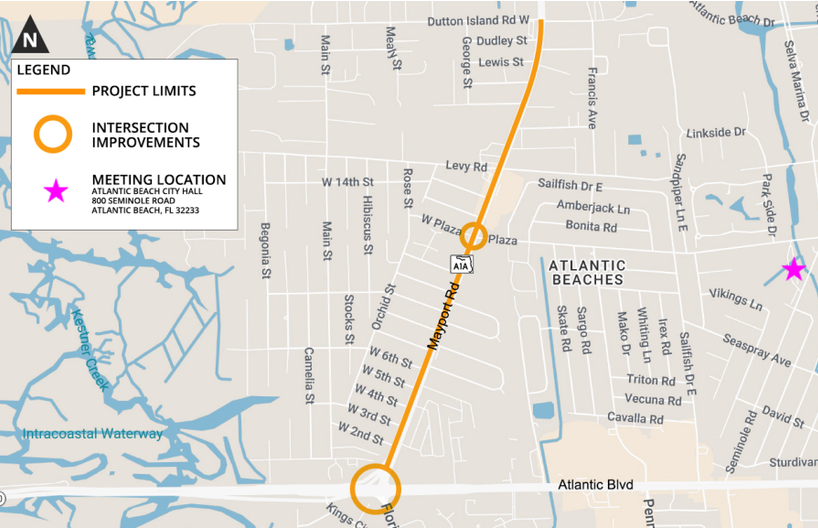
Former Atlantic Beach City Manager Shane Corbin said the project represents much more than a resurfacing effort, noting it grew out of long-term planning that included redevelopment goals and efforts to create a safer, more walkable community. "The long-term vision for the corridor was to soften that edge effect and connect the west side of Atlantic Beach with the east side," Corbin said, adding that pedestrian and bicycle safety remained central to the plan. "The road diet, multi-use trail and mixed-use node all fit together for what will make Mayport Road the future of Atlantic Beach." He described it as a comprehensive effort that also included the Marsh Oaks Business District, mixed-use redevelopment opportunities and the East Coast Greenway.
Not all residents oppose the project. Some support the addition of sidewalks, bicycle facilities, improved crossings and other pedestrian safety improvements, but question whether reducing vehicle capacity was necessary to achieve those goals. "Listen, we all think it would be nice to have nice sidewalks and a nice bike lane," said Atlantic Beach resident and small business owner Steven Meyer Jr. "I just don't think it had to come at the expense of two lanes, and I certainly never expected them to completely shut off the on-ramp to Atlantic Boulevard."
Atlantic Beach Mayor Curtis Ford said both past and present city commissions have consistently placed public safety at the forefront of the project. "The previous commission, as well as the current commission, has made the safety of our citizens a priority," Ford said. While acknowledging the inconvenience, he urged residents to consider the bigger picture. "I ask our residents to be patient with this disruption, knowing the expected goal. I just want our citizens to be able to cross the road."
Commissioner Jessica Ring, who represents the corridor-bordering district of Marsh Oaks, said the project is intended to create a safer road for motorists, pedestrians and cyclists through wider sidewalks, improved crosswalks, ADA-compliant facilities, buffered bicycle lanes and reduced vehicle speeds. Ring emphasized the importance of public outreach, both to this point and as the project continues. "You can never over-communicate on a project of this scale." She also recognized that residents are experiencing longer travel times and that those concerns are understandable, particularly with the return of school traffic approaching.
City Manager Kevin Hogencamp echoed those goals, noting that the project also includes infrastructure improvements such as drainage upgrades, lighting enhancements and utility work designed to serve the community for decades. He said the city continues working with FDOT to address inconvenience issues wherever possible, including signal timing and construction impacts.
Several officials emphasized that Mayport Road is a state roadway owned and managed by FDOT, with the City of Atlantic Beach serving primarily as a partner and advocate for residents throughout the process. FDOT officials say the project is intended to improve safety for everyone, not just motorists but also pedestrians and cyclists. According to FDOT Community Outreach Specialist Meg Ross, the changes include a reduced speed limit as part of FDOT's Target Zero initiative, a statewide effort to reduce serious crashes and fatalities. Ross said all changes were carefully evaluated to improve safety while maintaining efficient traffic operations, and the department believes the project will provide long-term benefits for the community.
Despite the sometimes confusing and frustrating state of affairs, city officials expressed optimism about the finished project. Ring said she believes residents will ultimately benefit from safer transportation options for pedestrians, cyclists and drivers alike. Hogencamp said he hopes that, once completed, the community will see a safer, more attractive and more connected corridor. Ford pointed to the corridor's troubled history as reason for hope in its future. "A safer multi-use path for bikes and pedestrians with reduced speed and synchronization of lights will help revitalize an area of Mayport Road that has been unsightly and unsafe for more than 50 years."
One day, the orange barrels will disappear. The lane shifts, detours and daily backups will become memories, replaced by a transformed corridor that officials hope will better serve Atlantic Beach for decades to come. Whether that vision fulfills its promise will ultimately be judged not by planners or politicians, but by the people who drive, walk and bike Mayport Road every day. Until then, the conversation continues, not just about traffic, but about safety, growth and the future of Atlantic Beach.


