

City officials opened fiscal year 2027 budget season on July 31st with a $253 million spending proposal, a flat property tax rate for the eighth straight year, and a warning that the biggest threats to the city's finances are being written 165 miles away in Tallahassee.
City officials followed the presentation with a bus tour of the sites the budget funds, from a drainage basin to a $230,000 dump truck. The city's annual Budget Showcase, held at City Hall and followed by a two-hour tour of public works sites, parks and the police station, is Jacksonville Beach's approach to putting physical objects behind budget line items. Council members, staff and members of the public were invited.
The financial picture presented by City Manager Mike Staffopoulos was, by his own description, still a good one. The city has been debt-free since 2020 and operates on a pay-as-you-go basis for capital projects. The proposed millage rate holds at 3.947 mills, below the statewide average of 4.8. Total spending rises about 2% over the current year. The general fund, the city's most flexible pot of money, comes in at roughly $35 million, a 7.3% increase.
Property values rose 7% across the city, an increase of $435 million, with a little over $100 million of that coming from new construction. Total taxable value now sits near $6.5 billion, roughly double what it was in 2007, with a visible trough during the recession years of 2011 and 2012.
Of the $253 million total, about $150 million is tied up in restricted utility funds, and just over $100 million of that is Beaches Energy alone.
What the city does not control
Staffopoulos spent a substantial portion of the presentation on what the city does not control.
Chief among them is the homestead exemption measure headed to voters. If it takes effect Jan. 1, 2027, every homesteaded property in Jacksonville Beach would receive an additional exemption, peaking at $250,000 per home after two years. The projected hit to the city is about $5 million a year, or one-seventh of the general fund.
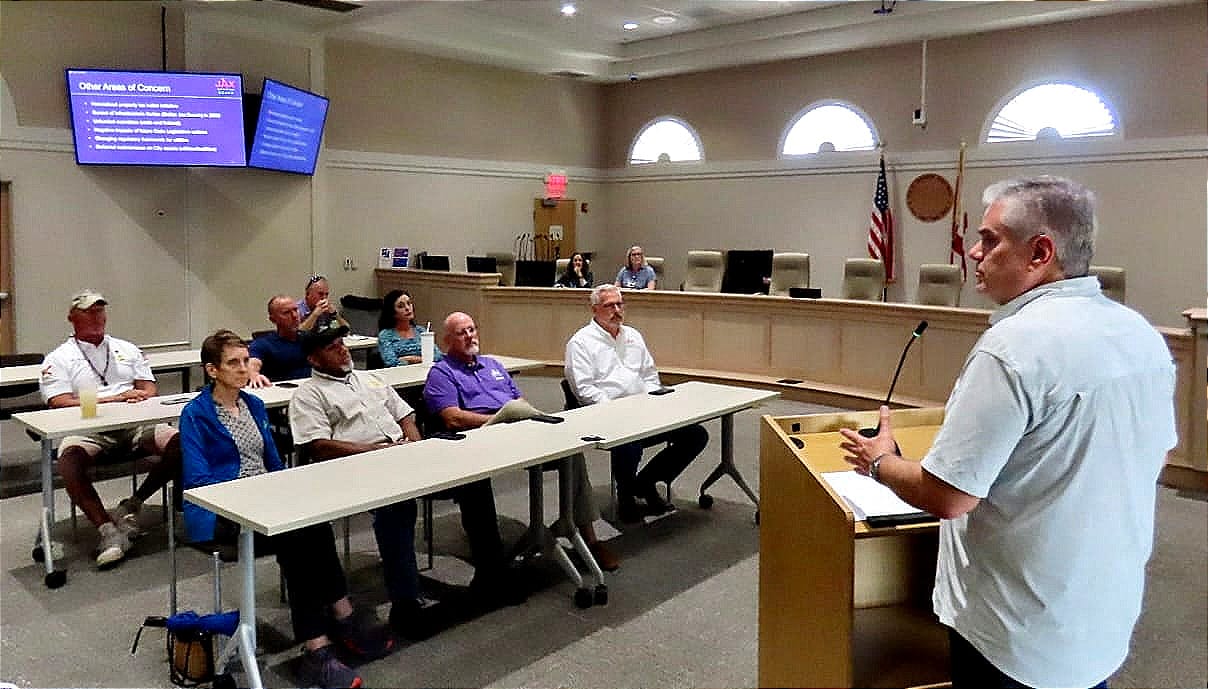
"Five million of the thirty-five could potentially go away," he said, "and we'd either have to talk about restructuring our level of service or generating additional revenue."
The Better Jacksonville infrastructure surtax sunsets in 2030, and the funds are currently used for road work. When Duval County voters approved the extension of that tax, they approved having those revenues directed to the city of Jacksonville to pay down its public pension obligations. Jacksonville Beach gets nothing beyond that date. Asked by Councilmember Sandy Golding to quantify it, Staffopoulos put the annual loss at $1.2 million to $1.5 million.
Inflation running at 3.5% or higher continues to outpace what the city budgets. COVID-era supply chain problems have not resolved; some vehicles and equipment still arrive 12 to 36 months after they're ordered, and some vendors will not guarantee pricing at all. Pension costs keep climbing, driven less by investment performance, since the plan returns above 8% annually according to the city's actuaries, than by the actuarial assumption being ratcheted down from 8% to 7.25%, with more reductions expected.
And then there are unfunded mandates. Staffopoulos pointed to Senate Bill 64 as an example: millions in wastewater compliance costs, with the city competing against every other municipality in Florida for grant money to cover a fraction of it.
Asked whether he had expected the state to move this aggressively against city revenues, he did not hedge. Every year the Legislature convenes, he said, is worse than the year before, and that has held for the last seven years.
Councilmember John Wagner did the arithmetic out loud: if inflation is running at 3.5% and the budget grew by 2%, the city is spending less in real terms than it did last year. He asked whether the city should begin formally tracking the cumulative cost of unfunded mandates in future budgets. It would be a way, he said, of showing residents what local tax dollars are being pulled away to cover.
For the average homeowner, the assessed value in Jacksonville Beach is now about $342,000 with a homestead exemption, producing a tax bill near $5,500. Just over 20% of that stays with the city. The rest goes to Duval County Public Schools and the city of Jacksonville. Of the general fund the city does keep, roughly 53% goes to police and fire.
A look at what the budget funds
The tour opened with a demonstration of the police department's new long-range acoustic device in the City Hall parking lot, placed some distance away from the assembled officials and volunteers at a reduced volume.
Chief Smith demonstrating crowd control equipment to Council members | Beach Gazette Staff
At the Jacksonville Beach Lifesaving Station, the city's Chief Financial Officer, Ashley Gossett, reported that the city received reimbursement Thursday on a $1 million grant from the city of Jacksonville covering window and stucco replacement. Deputy City Manager Karen Nelson walked the council through permanent exterior branding developed with the Volunteer Life Saving Corps and Jacksonville Beach Ocean Rescue, which goes to council for formal adoption Monday night. The south elevation will read "Home of the Volunteer Life Saving Corps," with "since 1912" added. The west side will read "Home of Jacksonville Beach Ocean Rescue." Painting is scheduled to be finished by Labor Day. A light gray steel roof is funded in the FY 2027 capital projects budget, with work to begin after hurricane season. The Reinhold historical plaque will be replaced with a brushed bronze replica.
The bus passed the city's archives building. Molly Alleger, Jax Beach City Clerk, noted that seventy-eight boxes have been moved to a new offsite records facility and more than 30 large bins of paper have been shredded as part of an ongoing effort to digitize the records. What happens to the building afterward, she said, is a council decision.
At the water plant, staff walked council members through the maintenance costs of eleven thousand water meters with roughly 15-year service lives, and through the condition of a plant built in 1991 that still runs on relay logic rather than modern programmable controllers.
Other stops covered six new murals painted by local artists, with staff signaling interest in partnering with the high school art program in FY 2027; the next phase of downtown streetscape reconstruction from 14th Avenue South through 16th Avenue South, which will be the first such project funded entirely with city dollars rather than CRA money; desilting and restoration of the central drainage basin on 13th Avenue South that carries most of downtown's stormwater; playground and trail improvements at Fountain View and Tall Pines parks, the latter selected by residents after roughly 500 door hangers went out; a new enclosed meter shop that was an open carport a year ago; and a procurement office moving to electronic solicitations through OpenGov with an Oct. 1 go-live date.
Radios, body cameras and a $986,000 negotiation
The tour ended at the police station, where the Communications Supervisor, Erin Citrullo, described renegotiating Motorola's system upgrade agreement after the vendor's opening proposal came in about 140% above the expiring six-year deal. Paired with a core infrastructure upgrade covering the dispatch console and radio base station, the negotiated package came down $986,000. Both items are headed to council on Sept. 8.
The department also previewed its body-worn camera rollout, an Axon package that includes automated report drafting, live streaming of activated cameras to dispatch, and real-time translation.
That drew the sharpest questions of the afternoon. Council Member Bill Horn asked whether the artificial intelligence layer, not the cameras themselves, creates legal exposure down the road, citing public friction over Flock camera systems. Staff said the department is not enabling facial recognition or lead generation, and that AI functions would be limited to report drafting and translation. Mayor Chris Hoffman pressed on data retention; staff said traffic stop footage defaults to 90 days, investigative footage is held until a case closes, and storage is unlimited under the subscription, held in Axon's cloud rather than the city's. Golding asked what verification is built into the workflow. Every report will still be read and approved by both the officer and a supervisor, staff said, and three employees will be assigned to video redaction because the software cannot reliably track a driver's license through a moving frame.
Council reviews each department's budget requests in detail at its budget workshops. On Monday, Aug. 3, council reviewed the Executive, Finance, Human Resources, Information Services and Legal Department budgets. Then on Tuesday, Aug. 4, the Police, Parks and Recreation, and Beaches Energy Services budgets were reviewed. The final workshop will be on Monday, August 10 at 5:30 pm when the Public Works, Planning Department, and Community Redevelopment Agency budgets are reviewed. All workshops are held at City Hall and are open to the public, though there is no public comment.


