

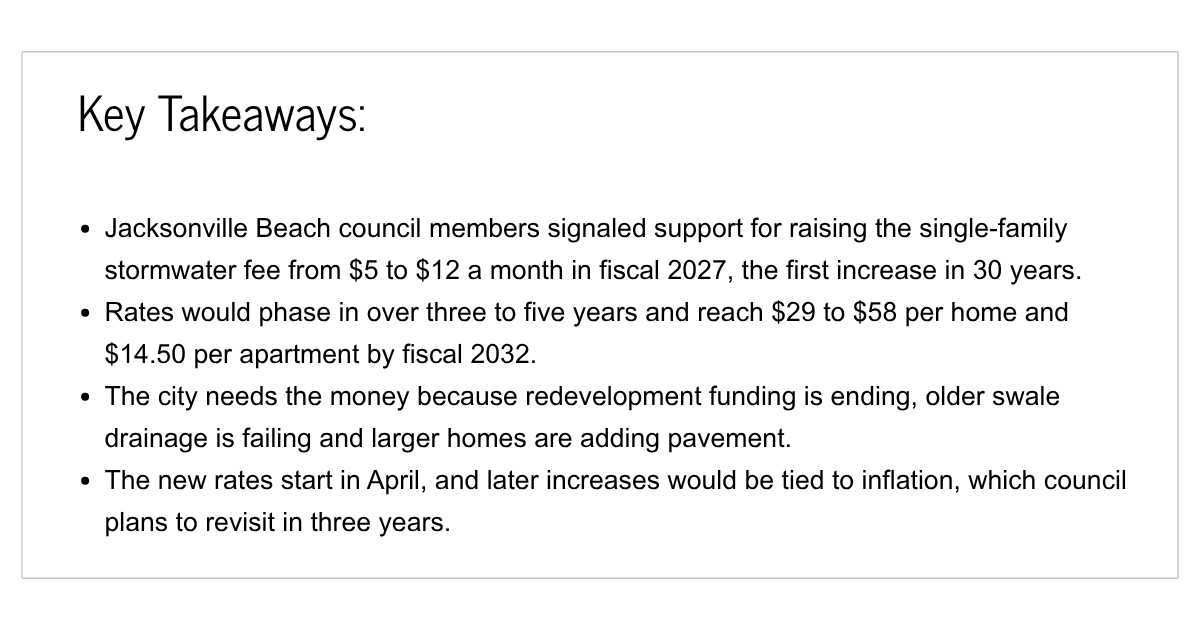
Jacksonville Beach City Council members signaled support for a new stormwater rate structure that would raise the monthly fee for most single-family homes from $5 to $12 next year, the first increase in three decades.
The increases would phase in over three, four or five years, reaching $29 a month for lower-tier homes, $58 for higher-tier homes and $14.50 per apartment by fiscal 2032. Council discussed the proposal during its Sept. 14 briefing.
The city is revisiting its stormwater rate now because the funding sources that have covered much of the system’s cost for years are drying up at the same time the system itself is under growing strain.
Staff said Jacksonville Beach has financed much of its stormwater capital work over the past decade through Community Redevelopment Agency tax-increment financing in its downtown and South Beach redevelopment districts. Those projects are largely wrapping up, leaving a funding gap the flat $5 rate was never designed to cover.
At the same time, City Engineer Kayle Moore said the city’s older neighborhoods are losing their original swale-based drainage as soil shifts or homeowners fill in roadside ditches. Those changes cannot be reversed and require costlier replacement systems. Redevelopment also continues to add impervious surface even without population growth, as older, smaller homes are replaced with larger ones.
Those pressures, combined with a rate that was set decades ago and never adjusted, prompted the city to bring in outside consultants to evaluate a new structure.
Hannah Palmer-Dwore, a senior consultant with Raftelis, presented findings from a joint rate study with engineering firm Jones Edmunds, building on work first presented in April.
The current system relies on the equivalent residential unit, or ERU, an industry-standard measure based on the median impervious area of a single-family home, calculated locally at 3,200 square feet.
After council members and staff asked for an alternative to ease the cost shift toward residential customers, the study team proposed a new billing unit equal to 2,500 square feet of impervious area. Multifamily properties would be billed at 0.5 units per apartment, up from 0.4 under the ERU model. Nonresidential properties’ share of total billing units would drop from an estimated 57.7% to 44.2%, while single-family would rise to 40.2% and multifamily to 15.6%.
A key reason the increase looks steep now is that the $5 rate was never indexed to inflation when it was set roughly 30 years ago.
“Had we tied this to CPI when we stopped it, the rate would be exactly the same” to what is being proposed, Public Works Director Dennis Barron said. “We just let it hit five and then we didn’t touch it for 30 years.”
Once full funding is reached, the proposal would tie future rates to the same Consumer Price Index the city uses for water and sewer. Council member Dan Janson raised concern about an open-ended tie: “You don’t put an end to it, then it just lives on perpetuity.” Members agreed that decision would wait for the three-year check-in planned for the rate structure itself.
Barron also said new stormwater rates would take effect each April, deliberately staggered six months from the city’s October water and sewer rate adjustments, so residents would not see both utility increases in the same billing cycle.
That timing means the first year of collections under the new structure would run only half a year, from April through September 2027. Staff said that would affect early capital project budgets, since revenue would come in more slowly than in a full fiscal year.
All three phase-in schedules start at $12 per month per billing unit in fiscal 2027. The three-year schedule jumps from $15 to $23 in a single year, which several council members said risked backlash. The five-year schedule spreads that climb more gradually.
Projected revenue reflects the trade-off: $5.1 million by fiscal 2029 under the three-year plan versus $4.2 million under the five-year plan.


